30 Fun Online Team Building Games from Hosts Who've Run 40,000+ Virtual Events
30 online team building games that actually work — hosted game shows ranked by real survey data, fun games with full instructions, free browser games for virtual teams, and quick meeting games — from the team behind 40,000+ virtual events.
Published
·
Updated
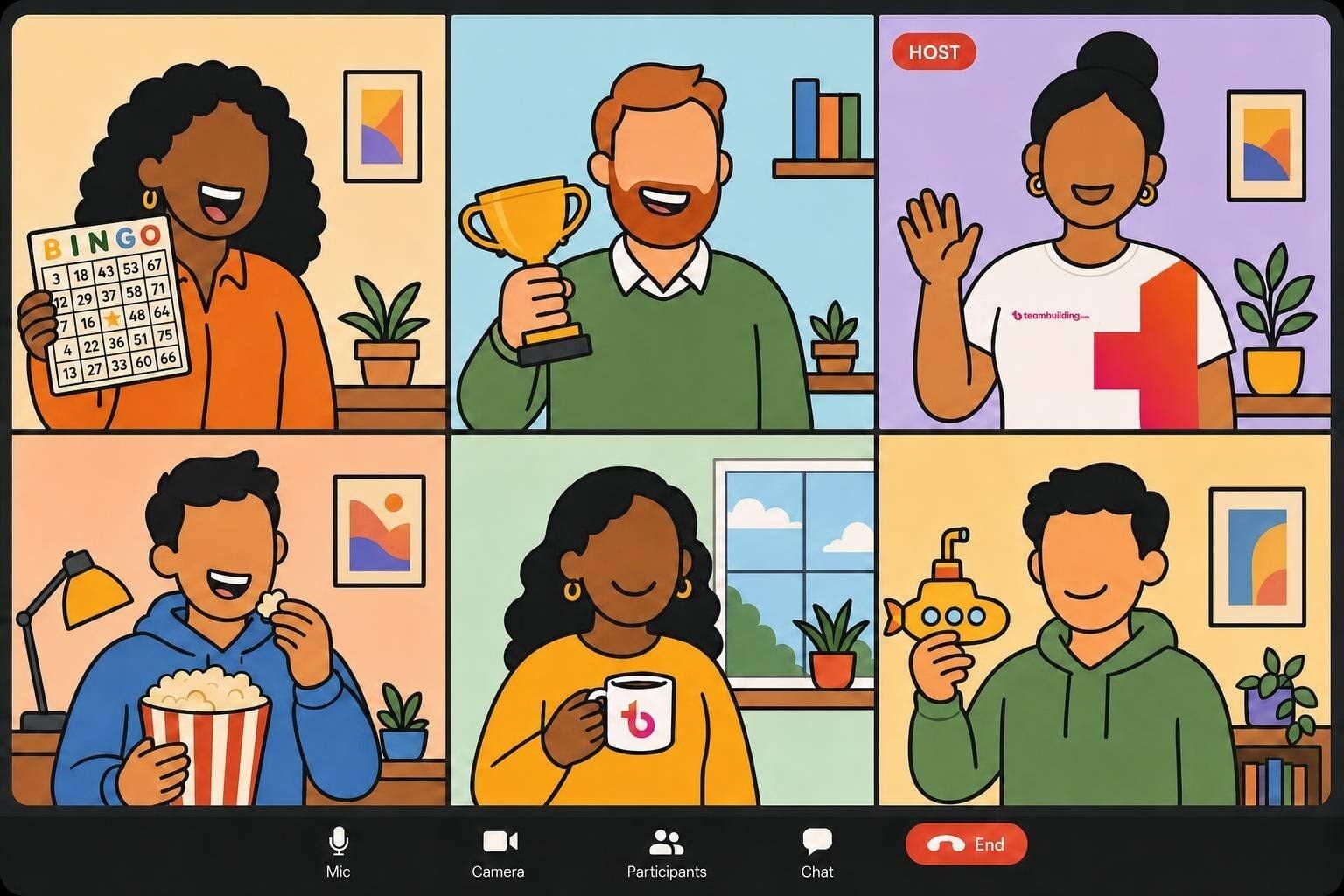
Online team building games are the fastest way to turn a grid of muted faces into a team that actually likes meeting together. We should know — as of August 2026, over 40,000 teams have booked virtual events with teambuilding.com, totaling nearly 1 million participants and 80,000+ reviews averaging 4.96 / 5. This guide is the games playbook from all of those events.
Below you will find 30 online team building games that work: hosted events ranked by real survey data, fun games with full instructions, free online games for virtual teams, and quick games you can run in the last ten minutes of a meeting. If you want the broader universe of formats beyond games — workshops, tours, and social formats — see our guide to virtual team building activities; this page sticks to games and how to run them.
Online team building games are games teams play together over the internet — on a video call, in a chat channel, or in a shared browser game — to build connection, communication, and team spirit. Examples include hosted game shows, Online Team Building Bingo, Skribbl, and lightning scavenger hunts. These games are also called "team building remote games," "interactive team building games," "virtual games to play with coworkers," and "online team games for work."
Games matter more online than they do in an office, because remote work does not create connection on its own. In a 2024 randomized controlled trial of 1,612 employees published in Nature, Stanford economist Nicholas Bloom and colleagues found that hybrid work reduced quit rates by one-third with no loss of performance — remote-friendly work is here to stay, which means the hallway conversations it replaces have to be rebuilt on purpose. A well-run game is the most reliable way we know to do that: it gives everyone a reason to unmute.
Best online team games for work, ranked by real survey data
The highest-rated way to play games online with coworkers is to have a professional host run the show, so every teammate — including whoever normally organizes these things — gets to just play. We rank our own hosted events with the Team Building Score, which combines confirmed bookings, verified reviews, ratings, and post-event survey outcomes. Here are the current top online games by that score:
Ranked by our Team Building Score — a running points total earned through confirmed bookings, verified reviews, ratings, and listing quality, recalculated nightly. Every event shown also has at least 30 post-event survey responses per question; the happier, connected, and NPS columns are computed from the 5,524+ survey responses collected for the 10 events listed here — a subset of all post-event surveys across our catalog. Updated September 2026.
Browse all hosted virtual events. Our hosts design dozens of new game concepts on an ongoing cycle: each one is play-tested internally with our own staff as the beta group, run live with client teams, iterated on using post-event surveys and reviews, and retired if it never finds its energy. Three favorites from that pipeline:
Online Office Games is a series of fun games and challenges for remote teams, led by a world-class host: speedy trivia in several formats, lightning scavenger hunts, and a communication game called "Can You Hear Me Now?" The challenges are designed specifically for distributed teams — they build connections while quietly exercising remote-work skills like giving clear, concise directions on a video call.
The event runs 90 minutes and includes breakout room sessions where teammates can strategize and get to know each other between rounds. It is our most-booked virtual event, and the format that taught us most of the lessons in this guide.
Ultimate Game Show turns your video call into a TV-style game show: teams compete through rapid-fire rounds of trivia, guessing games, and survey-says showdowns while an energetic host keeps score and keeps the jokes coming. The format is pure friendly competition — points, buzzers, and a leaderboard — which is exactly what participants tell us they love most about virtual events.
Best for: Competitive teams, big energy, 10–500+ people Time: 90 minutes Materials: None — a host runs everything
Murder in Ancient Egypt uses the mechanics of escape rooms — puzzles, code-breaking, riddles, and scavenger hunts — to get your team solving a murder together. The twist: the crime is a real mystery from ancient Egypt, and after your teams lock in their guess, our master storyteller shares the big reveal. Teams from companies like HubSpot, Reddit, and Pepsi have played it, and it remains one of our most-booked online murder mystery games.
Why does the puzzle structure work so well for teams? Here is teambuilding.com host Andrew Orsie: "The puzzle should feel doable, but ideally works best when the team splits up duties and works together a bit — if everyone can feel like they've participated and contributed, it's the most connecting and satisfying version of a team building puzzle game." And on the finale: "Plot twists are fun in movies, but you don't want your murder mystery solution to come in so far out of left field that no one feels like they could've gotten the answer themselves."
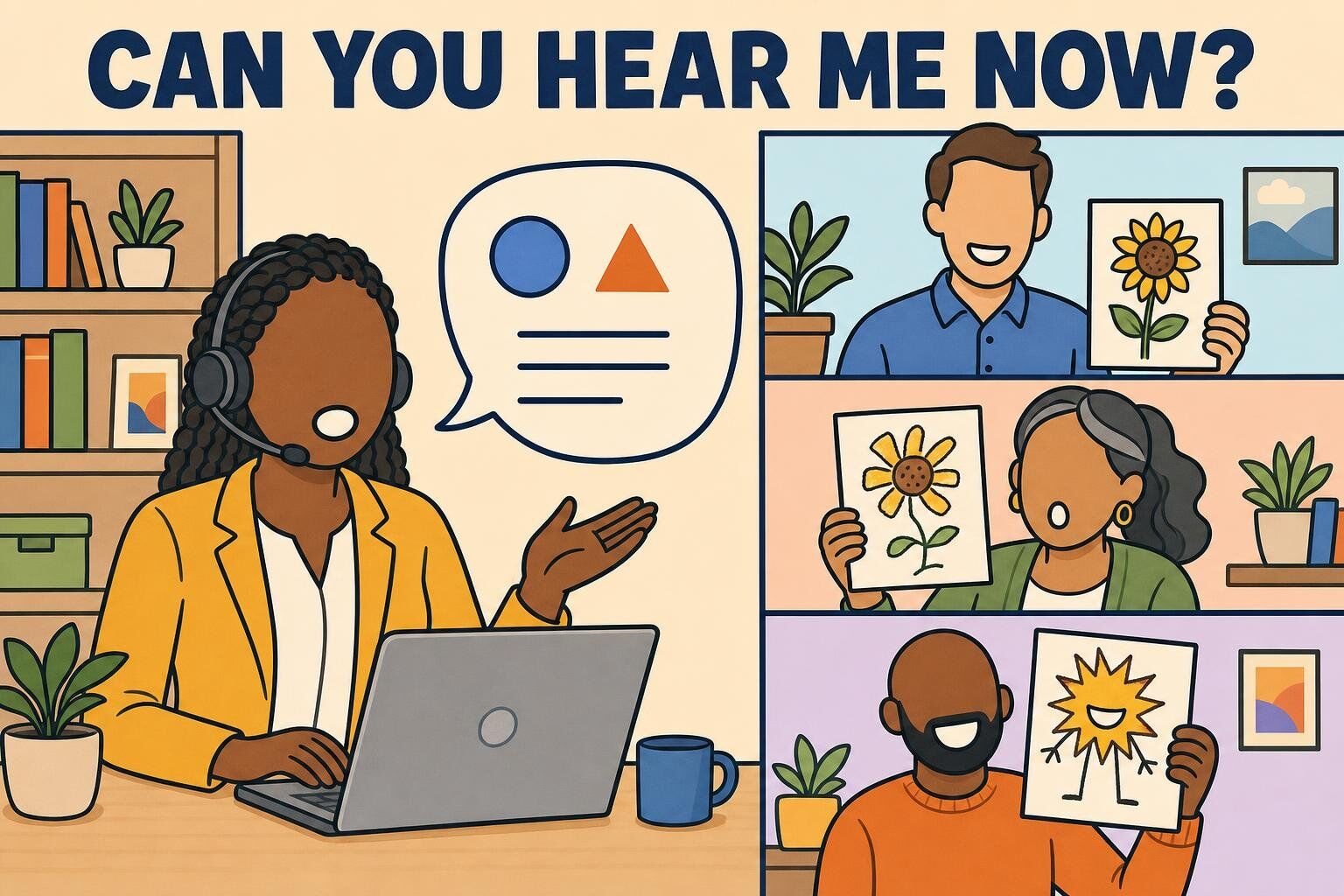
"Can You Hear Me Now?" is a communication game our hosts designed for Online Office Games, and it is playable on any video call. One player — the Describer — must get the other players — the Artists — to draw an object like a sunflower, kite, or calculator using only geometric terms. For the letter E, you might say: "Draw one vertical line, now a line from the top to the right, one from the middle to the right, and one from the bottom to the right."
To play:
Name one Describer per round; everyone else grabs paper and a pen.
The Describer gets a secret object and three minutes to describe it in shapes and lines only — no naming the object or its parts.
Artists reveal their drawings on camera and guess the object.
The Describer scores a point for each Artist who guesses correctly, and correct Artists score a point too.
The game is much harder than it sounds — and that is the point. People tend to give instructions based on what they already know the image looks like, rather than what the listener actually needs to hear, which is exactly the communication gap the game exposes. Expect the drawings to be gloriously wrong, and expect your team to talk about them for weeks.
Best for: Communication practice disguised as comedy, 4–30 people Time: 15–30 minutes Materials: Paper and pens (free)
5. Online Team Building Bingo
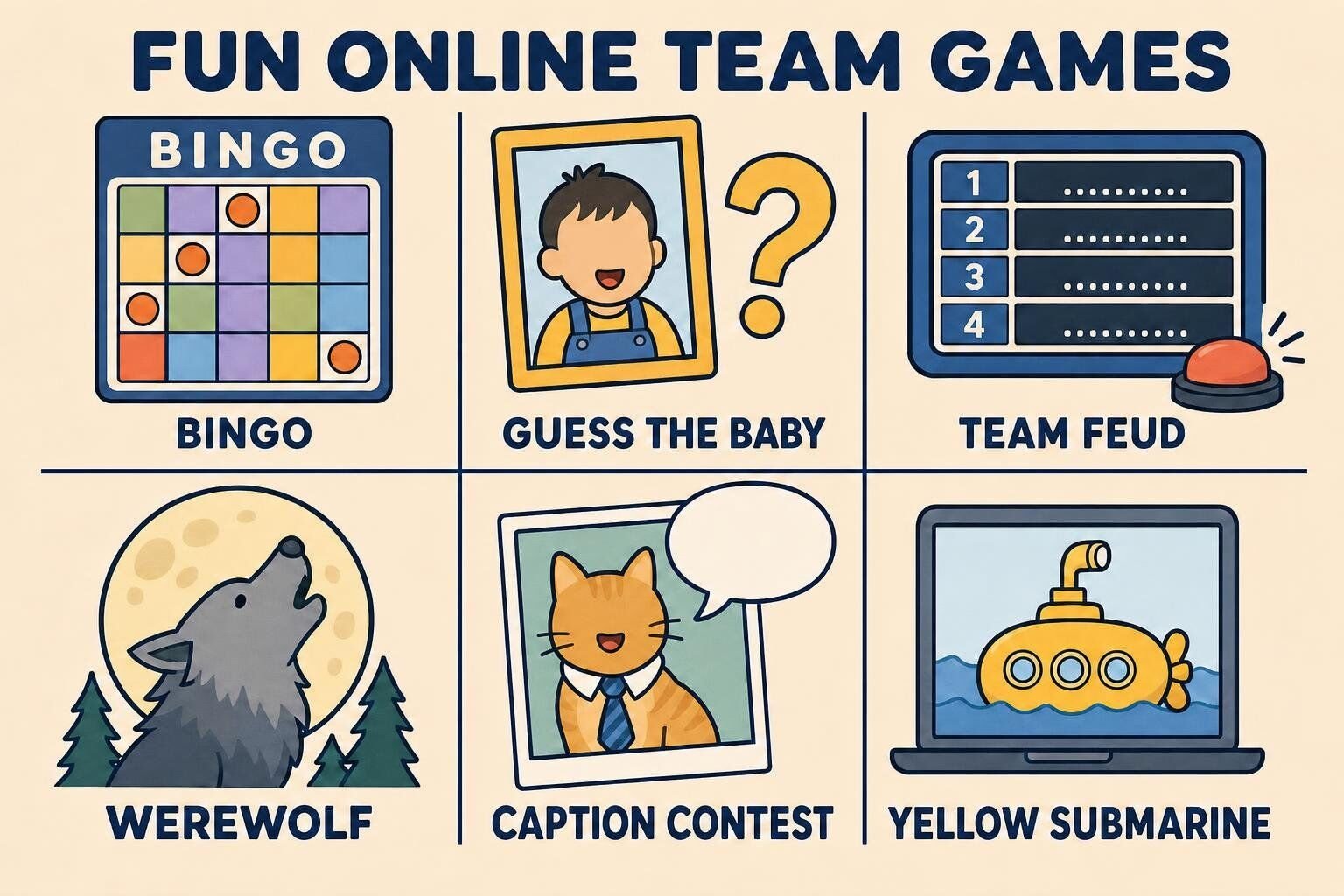
Online Team Building Bingo swaps numbers for descriptions and fun facts — "has a hidden talent," "is drinking coffee right now" — and challenges players to match squares to teammates. It is one of the easiest games to run with any group size, and it reliably surfaces the interesting facts that never come up in stand-ups.
Here is a board you can start with:
To play:
Distribute the board to your team.
Play for a set amount of time, like eight to ten minutes, with players chatting or dropping facts in the chat to claim squares.
First to five in a row calls Bingo; count up remaining Bingos and award prizes.
Groups of 20+ can split into breakout rooms to play in parallel; small groups can stay in the main room. Bragging rights are usually a sufficient prize.
Best for: Getting-to-know-you energy, 10–100+ people Time: 10–20 minutes Materials: Bingo boards (free above)
6. Guess the Baby
Guess the Baby is a photo guessing game: teammates submit childhood photos, the host shares them one at a time, and the group votes on who is who. The reveals are the payoff — nobody ever correctly matches the mohawk toddler to the quiet analyst.
To play:
Collect photos privately by email or DM a few days before the call.
Drop each photo on screen and collect guesses by poll or chat.
Reveal, award a point per correct guess, and let the photo's owner tell the story behind it.
What we've learned: toddler photos work much better than newborn photos, because recognizable features have started to develop — and unlike most games, this one actually gets better as the group gets larger, since more faces means harder matching.
Best for: Teams that have worked together a while, 5–50 people Time: 15–20 minutes Materials: Childhood photos, a poll tool (free)
7. Online Team Feud
Online Team Feud is a survey-says game show you build from your own office's opinions. In the week before the game, survey your team with a two-minute form — "name something that derails a video call," "name a food that should not be microwaved at work" — then reveal the top answers game-show style while two teams compete to guess them.
To play:
Send a five-question survey to the whole team and tally the top four to six answers per question.
On the call, split into two teams; alternate turns guessing the hidden answers on a shared slide deck.
Points equal the number of survey respondents who gave that answer; three misses passes control to the other team.
Playing with your own team's survey data is the trick — half the fun is discovering that eleven colleagues answered "reply all" and they are all willing to defend it. If you would rather have a host run the format, our hosted event Office Feud does exactly this with polished production.
Best for: Competitive groups, 10–60 people Time: 30–45 minutes (plus a pre-game survey) Materials: A survey form and a slide deck (free)
8. Online Werewolf
Werewolf is a social deduction classic that translates beautifully online, because it is primarily a speaking and strategy game. A narrator secretly assigns roles — Werewolves, Villagers, a Medic, and a Seer — then alternates "night" (cameras off, werewolves quietly pick a victim via DM) and "day" (cameras on, the group debates and votes on who seems suspicious).
To run it on a video call:
Assign roles by private message. For five players: 1 werewolf, 1 medic, 3 villagers; add 1 werewolf, 1 special role, and 3 villagers for every additional five players.
The narrator announces "night has fallen" — everyone turns cameras off while the werewolves, medic, and seer act via DM.
At sunrise, the narrator reveals the victim (or a save), and the group debates and votes to eliminate a suspect.
Repeat until only werewolves or villagers remain. Eliminated players become silent, friendly ghosts.
Best for: Teams that love strategy and bluffing, 5–20 people Time: 30–45 minutes Materials: None (free)
9. Caption Contest
In a Caption Contest, teammates write hilarious taglines for a random picture — a cat in a business suit, a raccoon holding a slice of pizza — and the group votes on the winner. You can run it live on a call or let it simmer all day in a chat channel.
To play:
The host drops a bizarre or oddly specific image into the chat.
Teammates respond with their best captions.
The group votes with emoji reactions, or the host picks a winner.
The game works because it taps into how remote teams already communicate — fast-moving threads, GIF reactions, inside jokes. A great caption is a tiny window into how a teammate thinks.
Best for: Async play in Slack or Teams, any group size Time: 10 minutes live, or all day in chat Materials: One funny image (free)
10. Yellow Submarine
Yellow Submarine is a stealth game that runs across many video calls: each player crafts a small submarine — paper, cardboard, magazine cutouts — and tries to sneak it on screen during regular meetings without being noticed. Hide it in your background, float it past the bottom of the frame, blend it into your coffee mug.
Scoring: one point every time your submarine appears on camera; if a teammate spots it and calls it out, you are out of the game (you keep the point). When everyone is out, tally points and crown the Yellow Submarine Captain. The incentive design is the fun part — showing your sub often earns points but risks getting caught, so meetings develop a delightful undercurrent of periscope-spotting.
Best for: Teams with lots of recurring calls, 5–30 people Time: Runs in the background for days or weeks Materials: Craft supplies (free)
Free online games for virtual teams
Every DIY game in this guide is free to run, but these five are free platforms — browser games your team can open and play in minutes, no budget approval required:
Skribbl.io is a free multiplayer drawing-and-guessing game — Pictionary in a browser. Players take turns drawing a secret word while everyone else races to guess it in the chat; blanks show the word's letters, and faster guesses score more points. Correct guessers are marked without revealing the word, so the round stays live for everyone else.
Create a private room, share the link on your video call, and screen-share the drawer's canvas if anyone gets lost. Up to 20 players can join a private room, and a custom word list — seeded with your company's inside jokes — makes the game roughly twice as funny.
Best for: Instant, zero-setup laughs, 3–20 people Time: 15–30 minutes Materials: Free browser game
12. Gartic Phone
Gartic Phone is the telephone game crossed with drawing: every player writes a silly sentence, then players alternate drawing the previous person's sentence and describing the previous person's drawing. After a few rounds, the game plays back each chain like a slideshow — and the mutation from "cat piloting a helicopter" to whatever it became is reliably the hardest a remote team laughs all quarter.
To play, create a free room, share the invite link, and pick a mode — "Normal" is perfect for first-timers. The playback is the main event, so screen-share it in the main room with everyone unmuted.
Best for: Creative teams, guaranteed laughter, 4–30 people Time: 15–30 minutes Materials: Free browser game
13. Codenames Online
Codenames is a word-association game of pure teamwork: two spymasters give one-word clues that connect multiple words on a shared 25-word grid, while their teams try to find their agents without hitting the assassin. The official free web version handles the board, so your call handles the agonized deliberation — which is where the team building happens.
Split the call into two teams, appoint spymasters, and keep a group chat or breakout room per team for debate. The game rewards knowing how your teammates think, and it gets better every time the same group plays.
Best for: Word lovers and deep-thinking teams, 4–12 people Time: 15–30 minutes per match Materials: Free official web app
14. Spreadsheet Battleship
Spreadsheet Battleship turns the software your team already lives in into a game board. Each player or pair builds a 10×10 grid in a shared spreadsheet, secretly places five ships, and then teams alternate calling shots — "B7!" — while marking hits and misses in their own grid.
To set up:
Make one spreadsheet tab per team with a labeled 10×10 grid; ships occupy 2–5 consecutive cells.
Teams place ships privately, then hop on a call and alternate calling coordinates.
Mark hits red and misses gray; first team to sink the whole fleet wins.
It is delightfully low-tech, it works behind even the strictest corporate firewall, and there is something deeply satisfying about defeating the finance team in their own habitat.
Best for: Office-tool humor, 2–20 people Time: 20–30 minutes Materials: A shared spreadsheet (free)
15. Free Online Escape Rooms
Online escape rooms are collaborative puzzle chains — find clues, crack codes, "escape" before the clock runs out — and there are solid free versions built in forms and slides that a team of four to ten can play on any call. Free rooms are usually a series of linked riddles; teams work in a breakout room and race other teams or the timer.
This format is ideal for small groups, because with fewer players everyone gets their hands on a puzzle. Here is our list of free online escape rooms — and if you want the fully produced version with live actors, our hosted game Solverance traps your team inside a suspiciously cheerful corporation with three professional hosts playing characters.
Best for: Puzzle-loving small teams, 4–10 per room Time: 45–60 minutes Materials: Free printable or form-based rooms
Quick and easy online team building games
These quick online games need zero prep and fit inside the first or last ten minutes of a meeting — the easiest way to make game time a habit rather than an event:
Lightning Scavenger Hunts are a format our hosts designed to get remote teammates up and moving: the host fires off a rapid series of clues, and players dash from their desks to find matching objects and win points. "Bring back your favorite mug" becomes a sprint, and the mug stories become the conversation.
Clue ideas to start with: something you have owned for more than ten years, the most colorful thing within reach, a souvenir from a trip, something you should have thrown away by now. Award bonus points for the best story, not just the fastest sprint — the stories are where the connection happens.
Best for: Energy resets mid-meeting, any group size Time: 5–15 minutes Materials: A clue list (free)
17. Ten Strikes
Ten Strikes is a get-to-know-you elimination game. All players hold up ten fingers on camera; players take turns sharing one true statement about themselves — "I have a pen pal" — and everyone for whom the statement is not true puts a finger down. Run out of fingers and you are out; last player standing wins.
The strategy is to share facts unique enough that everyone else loses a finger — which is exactly what makes the game good team building, because the winning moves are the most interesting personal stories. Play Five Strikes for a faster round, or Twenty Strikes if the team is on a roll.
Best for: New teams and new hires, 5–25 people Time: 10–15 minutes Materials: Ten fingers (free)
18. Best Wrong Answer
Best Wrong Answer flips quiz night on its head: the host asks an easy question — "What do you use an umbrella for?" — and players compete to give the funniest, most confidently incorrect answer in the chat. The winning wrong answer to "What's the best way to cook pasta?" might be, "Put it in the toaster and hope for the best."
Beyond the laughs, the game quietly breaks the stigma around not knowing things. Remote workers often hesitate to ask questions for fear of looking silly; a game that celebrates ridiculous answers makes the real questions easier to ask later.
Best for: Warming up a quiet call, any group size Time: 5–10 minutes Materials: A question list (free)
19. Tabloid Headlines
In Tabloid Headlines, each teammate writes an over-the-top news headline about their own work life: "Remote Worker Discovers New Time Zone, Accidentally Attends 3 AM Meeting" or "Employee Finally Clears Inbox, Immediately Gets 47 More Emails." The team votes for the most dramatic, relatable, or laugh-out-loud entry.
The game doubles as a pressure valve — it surfaces the unseen struggles of remote work in a way that gets laughed with, not complained about — and it gives quieter teammates a written format where their humor can shine.
Best for: Async or live play, any group size Time: 10 minutes Materials: A chat channel (free)
20. Virtual Charades
Charades works on a video call with two fixes our hosts swear by, because the classic version can lose energy inside a camera frame: spotlight the actor so everyone sees the performance full-screen, and keep rounds to a strict sixty seconds so the pace never sags.
The actor generates a prompt, the host spotlights them, and the sixty-second clock starts.
Teammates shout guesses; if they miss, the other team can steal.
Best for: Expressive teams, 6–20 people Time: 15–30 minutes Materials: Prompt generator (free above)
Online team building games for small groups
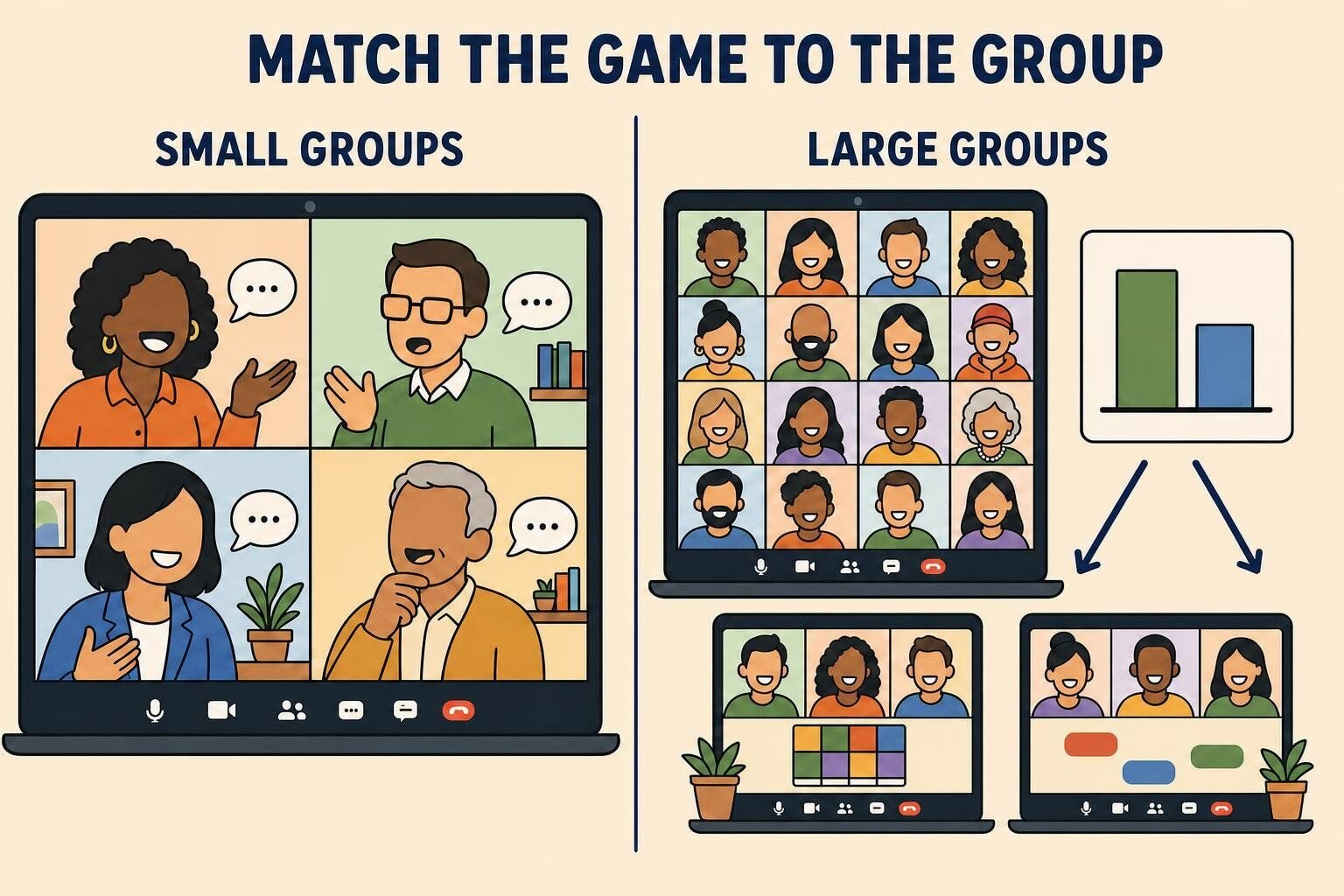
These games rely on discussion and turn-taking, which makes them best for small teams — in our experience the practical dividing line is about 15 people, below which a game can stay personal and high-touch without breakout rooms:
Something in Common sends small groups hunting for surprising similarities. Teams of four or five get a few minutes to find three things they all share — "we all have cats, none of us was born in this state, and we all loved Hamilton" — then share their finds with the full group.
Each round, add restrictions: no locations, no pets, no food preferences. The restrictions force the conversation deeper, and by round three teams are discovering genuinely unusual common ground. Small groups are the whole trick here — six people can discover something unusual they share; sixty people usually cannot.
Best for: New or newly merged teams, 4–15 people Time: 15–20 minutes Materials: None (free)
22. Pub-Style Trivia
You do not need a pub for pub trivia — just two or more teams, a question list, and a way to submit answers. Send teams to breakout rooms with five questions at a time in rounds of five to ten minutes, then reconvene for the answer reveal. Teams can submit via a form, or grade themselves on the honor system.
Because you are online, do not limit yourself to text questions: ultra-zoomed photos, five-second audio clips, and "real product or made up?" rounds play brilliantly on screens. Here are instructions for virtual trivia and a big list of trivia questions to build from.
Best for: Knowledge-proud teams, 6–15 people (or scaled up with breakouts) Time: 30–45 minutes Materials: Question list, optional form (free)
23. Truth or Dare: Remote Work Edition
This is a safe-for-work Truth or Dare optimized for video calls. The host calls on a player, they pick truth or dare, complete the challenge, and choose who goes next.
Here is a tool to generate random truth prompts:
And this one creates random dares:
For a variation, play Blackout Truth or Dare: the host poses one prompt to everyone, players willing to do it keep their cameras on while everyone else goes dark, and the host picks a volunteer from the lit tiles. The camera mechanic quietly adds a layer of consent — nobody is ever put on the spot without opting in.
Best for: Teams that already have some rapport, 4–15 people Time: 15–30 minutes Materials: Prompt generators (free above)
24. Desert Island Survival
Desert Island Survival is a discussion game: stranded on a desert island, each player may take three of the ten to fifteen items on offer — fire starter, water purifier, tent, multipurpose knife, fishing net, flashlight, rope — and must defend their picks to the group before a final vote scores each item's usefulness.
The scenario is an excuse; the game is really about hearing how teammates reason, negotiate, and change their minds. The best discussion scenarios have no obviously correct answer, which keeps the debate about thinking styles rather than trivia. Run it in breakout rooms for groups over ten, or as one lively main-room debate for smaller teams.
Best for: Hearing how teammates think, 4–15 people Time: 20–30 minutes Materials: An item list (free)
25. Backwards Storytelling
Backwards Storytelling starts with an ending — "And that's how we lost all our company pens" — and works backward, one sentence per teammate, until the story reaches a beginning. Teammates race to type the next line in the chat, and only the fastest contributions make the story.
Each player contributes exactly one sentence, so a ten-person team must build a coherent story in exactly ten lines. For groups over ten, split into breakout rooms, build competing stories, and vote on which one makes the most (or the most entertaining) sense.
Best for: Creative teams, 5–15 people Time: 10–20 minutes Materials: A chat window (free)
Online team building games for large groups
Large-group online games need simultaneous participation — polls, chats, and breakout rooms — so a crowd of 20, 100, or 500 can all play at once instead of waiting for a turn:
Overrated/Underrated is a debate game that scales to any size, because the whole crowd votes in a single recurring poll: the host reads a topic — reality TV, artificial intelligence, celebrity podcasts, plant-based diets — and everyone votes "overrated" or "underrated." After each reveal, dissenters get thirty seconds to defend the minority view and try to flip the room.
What we've learned: close votes are the most fun — a 52/48 split creates suspense and real debate, while a 95/5 split fizzles. Seed your topic list with genuinely contested picks, and drop the ones your team will all agree on.
Best for: All-hands energy, 20–500+ people Time: 10–20 minutes Materials: One reusable poll (free)
27. Online Pictionary
Pictionary scales to big groups through breakout rooms. Divide players into rooms of six to eight, have each person draw three clues from a random word generator, and let rooms play in parallel — one point per correctly guessed drawing, no points for skips. After fifteen minutes, reconvene and compare scores.
Vary the rules between rounds: verbs instead of nouns, non-drawing-hand rounds, or a lightning round of thirty-second sketches. Here are more online Pictionary games.
Best for: Breaking a big event into rooms, 20–100 people Time: 20–30 minutes Materials: Word generator, paper or whiteboard tool (free)
28. Slides with Friends
Slides With Friends turns a slide deck into a mass-participation game: players scan a QR code with their phones and respond to interactive slides — quizzes, word clouds, photo challenges, sound reactions — with everyone's answers appearing live on the shared screen. The platform ships ready-to-play decks, or you can build your own with company in-jokes.
Games run free for up to 10 players, with paid plans (from roughly $96/year) covering groups of 50 or more. Learn more about Slides with Friends and check out more presentation games.
Best for: All-hands and company-wide events, 20–500 people Time: 20–45 minutes Materials: Free up to 10 players; paid plans beyond
29. Mysterious Acronym Game
The Mysterious Acronym Game is a creativity challenge built for chat tools, which makes it effortless at scale. The host posts a nonsense acronym — "LMBQ" — and teams race to invent the funniest plausible meaning ("Let Me Buy Quiche") in their own threads, then vote with emoji reactions.
To play:
Start one thread per team in a shared channel and tag members into their threads.
Each team gets the same acronym; every player must contribute at least one meaning.
Teams emoji-vote their favorite, then post their winner to the main channel for a final all-company vote.
The game generates instant inside jokes — and the winning acronyms have a way of entering the company vocabulary permanently.
Best for: Async play across time zones, 20–100 people Time: 15 minutes live, or a day async Materials: A chat channel (free)
30. Jackbox Games
Jackbox Games is a library of 60+ polished party games — trivia, drawing duels, word games, bluffing games — that one person launches and screen-shares while everyone else plays from their phones using a room code. For work calls, start with the crowd-pleasers: Quiplash (funny answers), Drawful (terrible drawings), and Fibbage (bluffing).
To play with a remote team:
One player buys and launches a party pack, then screen-shares the game with sound.
Teammates join at Jackbox.tv on their phones with the room code.
Players beyond the per-game cap join as the audience and vote on winners.
The audience mechanic is what makes Jackbox work for bigger groups — latecomers and quiet teammates still get to influence the outcome without performing.
Best for: Game nights and happy hours, 10–100 people with audience mode Time: 30–60 minutes Materials: One-time party pack purchase (~$30)
Where to play: game platforms compared
Here is how the main options for online team games compare, from fully hosted events to free browser games:
The DIY games in this guide need nothing more than your existing video call and chat tools — and among the virtual events booked on teambuilding.com, clients host 82% on Zoom, 11% on Microsoft Teams, 4% on Google Meet, and 2% on Webex, so every game above is written to work on all four. If your team lives on Zoom, here is our dedicated list of Zoom games.
What we've learned from 40,000+ virtual events
Running online games at this volume produces patterns. Here is what the data — and our hosts — keep teaching us:
Competition is the engine. When we mine our reviews for what participants actually loved, friendly competition comes up again and again — points, buzzers, leaderboards, and team names give a session energy and a reason to stay engaged, while the stakes stay low: usually nothing more than bragging rights.
Games that force turn-taking build better teams. This one has research behind it: in studies of 699 people working in small groups published in Science, Anita Woolley and colleagues found that a group's collective intelligence was not strongly correlated with members' average individual intelligence — but was correlated with social sensitivity and equality of conversational turn-taking. Good game mechanics — one sentence per player, one clue per person, rotating describers — are turn-taking equality machines, which is a real reason games beat unstructured hangouts.
About 15 people is the dividing line. Below roughly 15 participants, online games can run personal and high-touch with many short rounds; above it, you need structured hosting, breakout rooms, polls, and fewer, longer rounds so everyone still participates. Match the game to your headcount before you fall in love with it — that is why this guide splits small group and large group games.
Book 60–90 minutes. 88% of virtual team building events run 60 to 90 minutes, making it by far the most common format length — and when clients book shorter sessions, nine times out of ten they say afterward that they wish they had booked the full event, because under an hour the session ends right as quieter teammates warm up. For meeting games, invert the rule: ten minutes inside a sixty-minute meeting is the habit that compounds.
The host matters more than the software. Roughly one in five published reviews of our virtual events mention the host by name — participants remember who ran the show, not which platform it ran on. For DIY games, that means your emcee choice matters: pick someone who enjoys the mic, and rotate the role so it never becomes a chore. Remote connection is a topic our leadership has been asked about since the earliest lockdown days, including in The Economist's "The World Ahead: The Future of Work" — and the answer has stayed the same: distributed teams thrive when connection is scheduled, structured, and fun.
Online games we don't recommend
Some formats consistently fail on video calls. Having hosted virtual events since 2020, here is what we would skip — and what to run instead:
Idea
Why skip it
Run instead
Virtual karaoke
Latency breaks the sing-along, and the mic pressure lands on one person at a time.
The best online team building games share three traits: everyone gets a turn, the competition is friendly, and the setup never upstages the fun. Start with one quick game in your next team meeting, graduate to a monthly free browser game session, and when you want the full production — host, points, and a leaderboard your team will argue about for weeks — book a hosted online game and just play.
Whatever you pick, put it on the calendar. Online connection does not happen by accident, and thirty minutes of games does more for a distributed team than any amount of "we should really do something soon."
Answers from the team behind 40,000+ virtual events for clients like Google, Amazon, and Deloitte.
What are good online team building games?
The best online team building games include hosted events like Online Office Games, Ultimate Game Show, and Murder in Ancient Egypt, DIY games like Can You Hear Me Now?, Online Team Building Bingo, and Online Team Feud, and free browser games like Skribbl, Gartic Phone, and Codenames Online. The strongest games give every player a turn and add friendly competition with points and a leaderboard.
What games can you play online with coworkers?
With coworkers, you can play quick video call games like Lightning Scavenger Hunts, Ten Strikes, and Best Wrong Answer, chat-based games like Caption Contest and the Mysterious Acronym Game, and browser games like Skribbl and Gartic Phone. For a bigger occasion, teams book hosted games such as trivia game shows and murder mysteries with a professional host.
What are free online team building games?
Free online team building games include Skribbl, Gartic Phone, Codenames Online, Spreadsheet Battleship, and form-based free escape rooms — plus zero-cost DIY games like Online Team Building Bingo, Werewolf, and Desert Island Survival that run on the video call and chat tools your team already uses.
How long should online team building games last?
For a dedicated event, book 60 to 90 minutes — 88% of virtual team building events run in that window, and shorter sessions tend to end right as quieter teammates warm up. For everyday meetings, a 5 to 10 minute quick game at the start or end is the habit that keeps remote teams connected between events.
How many people do you need for online team building games?
Most online team building games work with 4 to 20 players, and the median virtual team building event has 16 participants. About 15 people is the practical dividing line: smaller groups suit discussion and turn-taking games, while larger groups need polls, breakout rooms, and structured hosting — hosted formats scale to events with hundreds of participants.
What platform do teams use for online team building games?
Among virtual team building events booked on teambuilding.com, clients host 82% on Zoom, 11% on Microsoft Teams, 4% on Google Meet, and 2% on Webex. Most online team building games are platform-agnostic — any video call tool with chat, screen sharing, and breakout rooms will run every game on this list.
Comments (331)
Cynthia Escobar
Thank you for sharing these great idea for team building!
Regina
Any ideas for a virtual Holiday party for 100 employees? Not sure if it makes sense with such a large group.
Michael Alexis
Hi Regina! We have a list of virtual holiday party ideas here: https://teambuilding.com/blog/virtual-holiday-party
We also offer virtual holiday parties as a service, and work with many large groups 🙂
Tiffany
Name, Place, Animal, Thing. Pick a letter. Each player has to list a famous person's name, a place, an animal, and a thing that begins with that letter. The first person to type them in the chat wins.
John
How about I Wish I Could Travel.
1st member = I Wish I Could Travel and when I do, I'm going to bring: a laptop.
2nd member = I Wish I Could Travel and when I do, I'm going to bring: a cell phone and a laptop.
3rd member = I Wish I Could Travel and when I do, I'm going to bring: a toothbrush, a cell phone, and a laptop.
And so on.
Each member has to mention an item they would carry with them or pack in their luggage. As each member goes along, they have to mention one item and also mention what the previous member(s) have also mentioned in backward order. From the most recent one mentioned until the first one mentioned. Whoever misses mentioning one previous item or in the wrong order, they're out!
Rose
Hang man is fun. Also playing virtual flip cup with real cups on either side!










Thank you for sharing these great idea for team building!
Any ideas for a virtual Holiday party for 100 employees? Not sure if it makes sense with such a large group.
Hi Regina! We have a list of virtual holiday party ideas here: https://teambuilding.com/blog/virtual-holiday-party
We also offer virtual holiday parties as a service, and work with many large groups 🙂
Name, Place, Animal, Thing. Pick a letter. Each player has to list a famous person's name, a place, an animal, and a thing that begins with that letter. The first person to type them in the chat wins.
How about I Wish I Could Travel.
1st member = I Wish I Could Travel and when I do, I'm going to bring: a laptop.
2nd member = I Wish I Could Travel and when I do, I'm going to bring: a cell phone and a laptop.
3rd member = I Wish I Could Travel and when I do, I'm going to bring: a toothbrush, a cell phone, and a laptop.
And so on.
Each member has to mention an item they would carry with them or pack in their luggage. As each member goes along, they have to mention one item and also mention what the previous member(s) have also mentioned in backward order. From the most recent one mentioned until the first one mentioned. Whoever misses mentioning one previous item or in the wrong order, they're out!
Hang man is fun. Also playing virtual flip cup with real cups on either side!