
Virtual Escape Rooms: 18 Best Online Escape Games for Teams, Ranked
The best virtual escape rooms for team building, from hosted games ranked by Team Building Score to free online escape rooms and the puzzles our game designers use to build them.
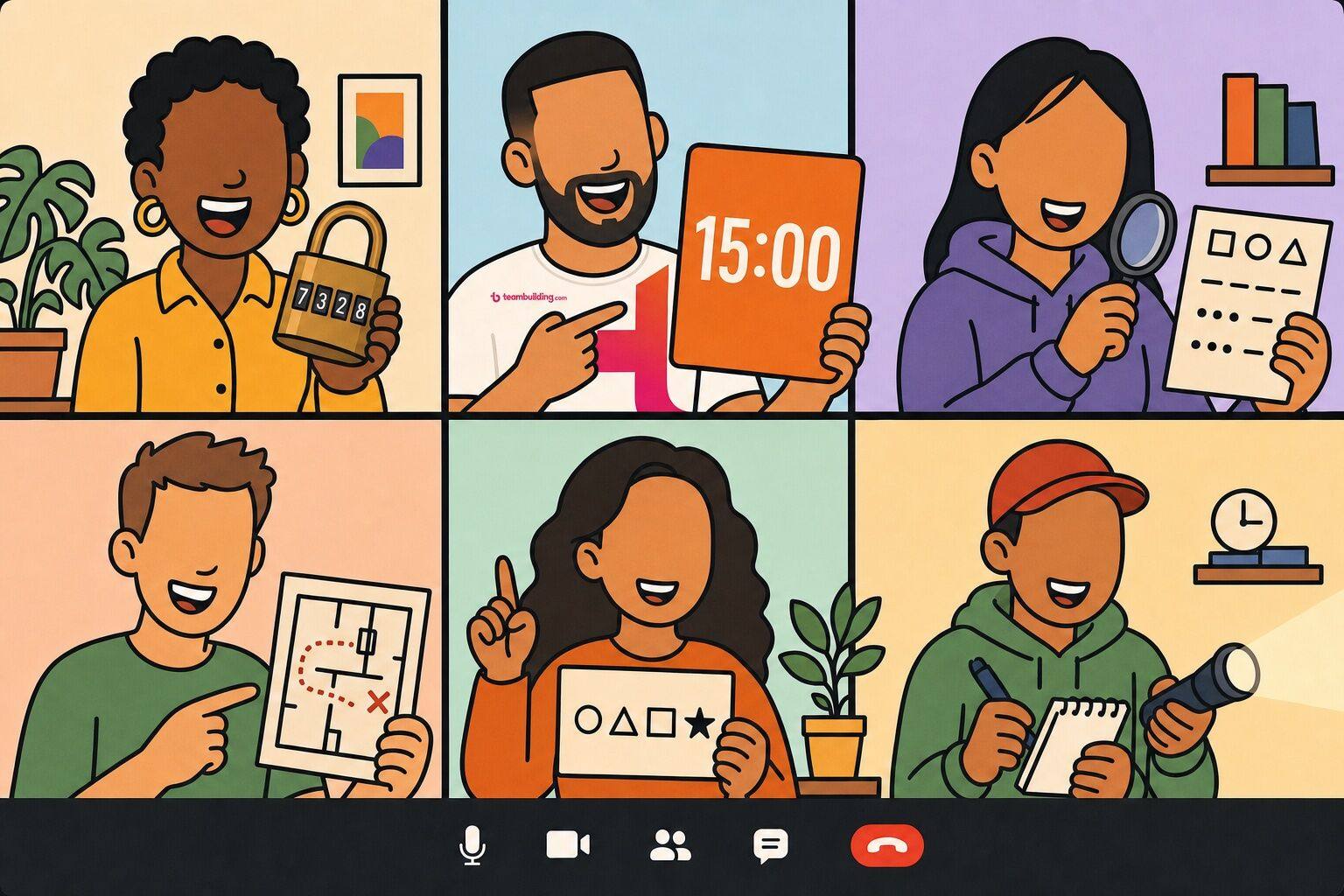
The best virtual escape rooms for team building, from hosted games ranked by Team Building Score to free online escape rooms and the puzzles our game designers use to build them.
We started running virtual escape rooms in 2020, when teams that used to book our in-person scavenger hunts suddenly needed something that worked on a video call. Six years later they are one of the formats we run most. As of August 2026, over 40,000 teams have booked virtual events with teambuilding.com, totaling nearly 1 million participants and 80,000+ reviews averaging 4.96 out of 5.
This guide ranks the hosted virtual escape rooms our teams run, compares the other companies worth booking, lists the best free online escape rooms you can play this afternoon, and walks through the puzzles our game designers use so you can build a room yourself. Every price, group size, and rating below comes from our own catalog and platform data.
Trusted by teams at


This list includes:
Prefer to watch? Here is a quick look at the kind of online puzzle games our hosts run:
A virtual escape room is an online game where a group works against a clock to solve ciphers, riddles, and hidden-object puzzles inside a themed story, with the goal of "escaping" before time runs out. Hosted versions run on a video call with a live game master who narrates the story, drops hints, and keeps score. Self-guided versions run in a browser, usually as a Google Form or a set of linked slides that checks your answers for you. These games are also called "online escape rooms," "digital escape rooms," "Zoom escape rooms," and, confusingly, "virtual breakout rooms."
Virtual escape rooms are a subcategory of virtual team building activities and online team building games. They are similar to virtual murder mystery games, virtual crime scene investigation games, and the virtual scavenger hunt, and the category includes free online escape rooms and the escape room puzzles you can build yourself. Teams book them for remote onboarding, quarterly all-hands, and holiday parties, and pick a story from the usual escape room themes: heists, haunted houses, spy missions, and ancient tombs.
Hosted rooms solve the two problems that sink most self-guided attempts: nobody on your team has to run the game, and the pace does not stall when one puzzle stumps the group. The table below ranks our puzzle-based Originals by Team Building Score, a points total each event earns from confirmed bookings, participant reviews and ratings. Events also need a minimum number of post-event survey responses to qualify, and those surveys supply the table's outcome columns.
| # | Event | Score | Rating | Happier | Connected | NPS | Price |
|---|---|---|---|---|---|---|---|
| 1 | 
Murder in the Speakeasy
Best for: History buffs and mystery lovers
More about this eventA prohibition-themed murder mystery where teams collect clues and crack the case.
Perfect for: History buffs and mystery lovers, Teams seeking immersive experiences, Corporate retreats with a twist |
245 | ★ | 97% | 91% | 80 | $40 pp |
| 2 | 
Murder in Ancient Egypt
Best for: Teams seeking a thrilling challenge
More about this eventWork together on puzzles & solve a real (ancient) murder mystery.
Perfect for: Teams seeking a thrilling challenge, Improving problem-solving skills, Virtual team building events |
245 | ★ | 96% | 90% | 73 | $45 pp |
| 3 | 
Espionage!
Best for: Teams seeking adrenaline-pumping fun
More about this eventA social deduction game with puzzles, challenges, and sabotage.
Perfect for: Teams seeking adrenaline-pumping fun, Groups wanting a strategic challenge, Virtual team-building events |
245 | ★ | 97% | 92% | 80 | $40 pp |
| 4 | 
Ghost Hunt in the Haunted Mansion
Best for: Teams seeking thrilling experiences
More about this eventAn online escape-room-esque game in the famously haunted Winchester Mansion.
Perfect for: Teams seeking thrilling experiences, Halloween-themed team events, Groups wanting a spooky challenge |
240 | ★ | 99% | 93% | 82 | $45 pp |
| 5 | 
Art Heist: The Vanishing Van Gogh
Best for: Teams who love a challenge
More about this eventA whodunit where teams must follow clues to retrieve a famous painting.
Perfect for: Teams who love a challenge, Art enthusiasts and mystery lovers, Building problem-solving skills |
238 | ★ | 97% | 91% | 80 | $40 pp |
| 6 | 
Escape Dracula's Castle
Best for: Teams seeking a thrilling challenge
More about this eventA social deduction escape game full of sabotage. Find the vampires and escape the castle before time runs out.
Perfect for: Teams seeking a thrilling challenge, Virtual team bonding sessions, Fans of mystery and deduction |
214 | ★ | 99% | 93% | 79 | $45 pp |
| 7 | 
Escape Everest: Quest for the Yeti
Best for: Teams seeking a thrilling challenge
More about this eventCan your team find the yeti and escape Everest?
Perfect for: Teams seeking a thrilling challenge, Virtual team-building events, Groups interested in folklore |
207 | ★ | 96% | 89% | 74 | $40 pp |
| 8 | 
Solverance
Best for: Teams seeking a fun challenge
More about this eventA game for clever innies inspired by the hit TV series.
Perfect for: Teams seeking a fun challenge, Fans of immersive experiences, Groups wanting to enhance collaboration |
182 | ★ | 97% | 87% | 74 | $49 pp |
| 9 | 
Escape from the Haunted Ship
Best for: Teams seeking thrilling challenges
More about this eventYour team’s survival depends on solving the mystery before it’s too late…
Perfect for: Teams seeking thrilling challenges, Halloween-themed virtual gatherings, Problem-solving enthusiasts |
119 | ★ | 98% | 87% | 80 | $45 pp |
| 10 | 
The Odyssey: A Collaborative Quest
More about this eventEmbark on an epic quest while collaborating with your colleagues to solve puzzles and complete challenges based on Homer’s The Odyssey. |
70 | ★ | 100% | 98% | 85 | $40 pp |
Ranked by our Team Building Score — a running points total earned through confirmed bookings, verified reviews, ratings, and listing quality, recalculated nightly. Every event shown also has at least 30 post-event survey responses per question; the happier, connected, and NPS columns are computed from the 5,231+ survey responses collected for the 10 events listed here — a subset of all post-event surveys across our catalog. Updated October 2026.
Here are the six we recommend most often, and who each one suits.
A game for clever innies inspired by the hit TV series.
Solverance drops your team inside an office full of eccentric, faintly suspicious characters and asks you to solve your way out, department by department. Over 60 minutes, players decode clues, uncover a few twists, and race the clock while a host keeps the story moving. It is our newest puzzle Original and the one we recommend for teams who want the escape-room mechanics without a spooky or historical setting, with a 4.95 out of 5 rating across 430 reviews as of August 2026.
Best for: 10 to 1,000 players who want a modern, workplace-flavored story
Time: 60 minutes
Materials (cost): Hosted, $49 per person
What we've learned: The 60-minute version moves fast, so we ask groups to name a note-taker before the story starts. One person tracking which clues are already solved saves the group about five minutes of re-reading in the final act.
An online escape-room-esque game in the famously haunted Winchester Mansion.
Ghost Hunt in the Haunted Mansion blends an escape room with a haunted house tour. The setting is the Winchester Mystery House, the real California mansion with staircases that lead nowhere. Over 90 minutes, players work as paranormal investigators, hunting clues, deciphering codes, and solving puzzles before they are trapped in the halls for good. A host guides the investigation and adjusts the scare level for the room.
Best for: 10 to 1,000 players, and any team that wants a Halloween event that is not a costume contest
Time: 90 minutes
Materials (cost): Hosted, $40 per person
What we've learned: Spooky is a dial, not a switch. Our hosts ask the organizer beforehand whether the group wants atmospheric or genuinely creepy, because the same script lands very differently on a team that includes people who hate jump scares.
Murder in Ancient Egypt is our most-reviewed puzzle game: 4.94 out of 5 across 3,322 reviews as of August 2026. A pharaoh is dead, the suspects are all in the room, and your team has 60 or 90 minutes to work through hieroglyphic ciphers, tomb maps, and witness statements to name the killer. It is the best pick for a first-timer group because the early puzzles teach the mechanics before the difficulty ramps.
Best for: 10 to 1,000 players, mixed experience levels
Time: 60 or 90 minutes
Materials (cost): Hosted, $45 per person
What we've learned: The 90-minute version is worth the extra half hour for groups over 30. The 60-minute script is tight, and larger rooms lose a few minutes to breakout transitions that smaller rooms never feel.
Escape Everest is a mountaineering story: your expedition is pinned down on the mountain, supplies are thin, and the route out depends on solving a chain of puzzles about the terrain, the weather, and the yeti tracks nobody wants to talk about. It runs 60 or 90 minutes and holds a 4.93 out of 5 rating across 1,855 reviews as of August 2026. The format scales unusually well, which is why it is our default recommendation for all-hands-sized groups.
Best for: 10 to 1,000+ players, including very large all-hands groups
Time: 60 or 90 minutes
Materials (cost): Hosted, $40 per person
What we've learned: Puzzle games are the one virtual format where mixing departments actively helps. A cipher, a map, and a word puzzle reward different brains, so teams that draw from finance, design, and support tend to finish ahead of intact departments.
Escape Dracula's Castle is the gothic entry in the catalog: your team is inside the castle, the doors have locked behind you, and the way out runs through crypt riddles, a candlelit cipher, and a final combination you assemble from earlier clues. It rates 4.93 out of 5 across 1,019 reviews as of August 2026 and is one of our two most-booked October events.
Best for: 10 to 1,000+ players, seasonal and Halloween events
Time: 60 or 90 minutes
Materials (cost): Hosted, $40 per person
What we've learned: October books out first. Our haunted titles fill faster than any other seasonal format, so teams that want a late-October slot tend to reserve six to eight weeks ahead rather than the usual three.
Art Heist is our highest-rated puzzle game at 4.98 out of 5 across 1,039 reviews as of August 2026. A Van Gogh has vanished from a museum, and over 90 minutes your team examines the gallery, works the forensics, and follows the forgery trail to recover it. The story leans on our Museum Hack roots, and it is the room to pick when a group has already played one of the murder-mystery formats and wants something with a different rhythm.
Best for: 10 to 1,000 players, repeat groups who have played a mystery before
Time: 90 minutes
Materials (cost): Hosted, $40 per person
What we've learned: Heist stories give quieter teammates a natural entry point. The evidence puzzles reward noticing small details rather than talking fastest, and in our rooms the person who cracks the forgery clue is rarely the person who was loudest in the first ten minutes.
Want more options? Browse all of our hosted virtual events →
Plenty of companies sell online escape rooms, and the quality range is wide: some are genuinely designed for a video call, and some are a physical room's puzzles photographed and pasted into a slide deck. We are obviously biased, so we have kept our take on each one short and honest, including the free route that costs nothing at all.
| Company | Type | Typical price | Best for | Our take |
|---|---|---|---|---|
| teambuilding.com | Team building company | $40–$49 per person | Hosted puzzle games designed for remote teams, 10 to 1,000+ players | Our pick for hosted virtual escape rooms. Every game is built in-house, run by trained staff hosts, and refined from post-event surveys across tens of thousands of events. |
| The Escape Game | Escape room operator | Custom quotes; priced on their site | Teams that want a remote version of a real physical room, with a game guide on camera | The strongest crossover from physical escape rooms. Their remote adventures stream a live guide who acts as your hands inside an actual set, which feels closer to the in-person experience than a slide-based room. |
| Puzzle Break | Escape room operator | Custom quotes | Small groups that want a classic story-driven room over video | An early pioneer of both physical and virtual escape rooms. Their fairy-tale and adventure stories are well built, and a game master runs each session live. |
| Confetti | Experiences marketplace | Priced live on their site | Teams comparing many vendors and price points in one place | A broad marketplace rather than a game designer. Useful when you want to browse several escape and mystery formats side by side, though quality varies by the provider behind each listing. |
| Free browser rooms | Library and museum built, self-guided | Free | Small teams, short sessions, and zero budget | Genuinely fun and completely free, but there is no host, so someone on your team has to run the call and keep the group moving. See our picks below. |
Booking a host is not the only route to a good game, though. The next sections cover what actually happens in a hosted room, the best free options, and how to build a room yourself.
Nearly every hosted virtual escape room follows the same arc: everyone joins one video call, the host sets up the story, the group splits into smaller teams, each team works through a puzzle chain, and the room reconvenes for the final code and a debrief.
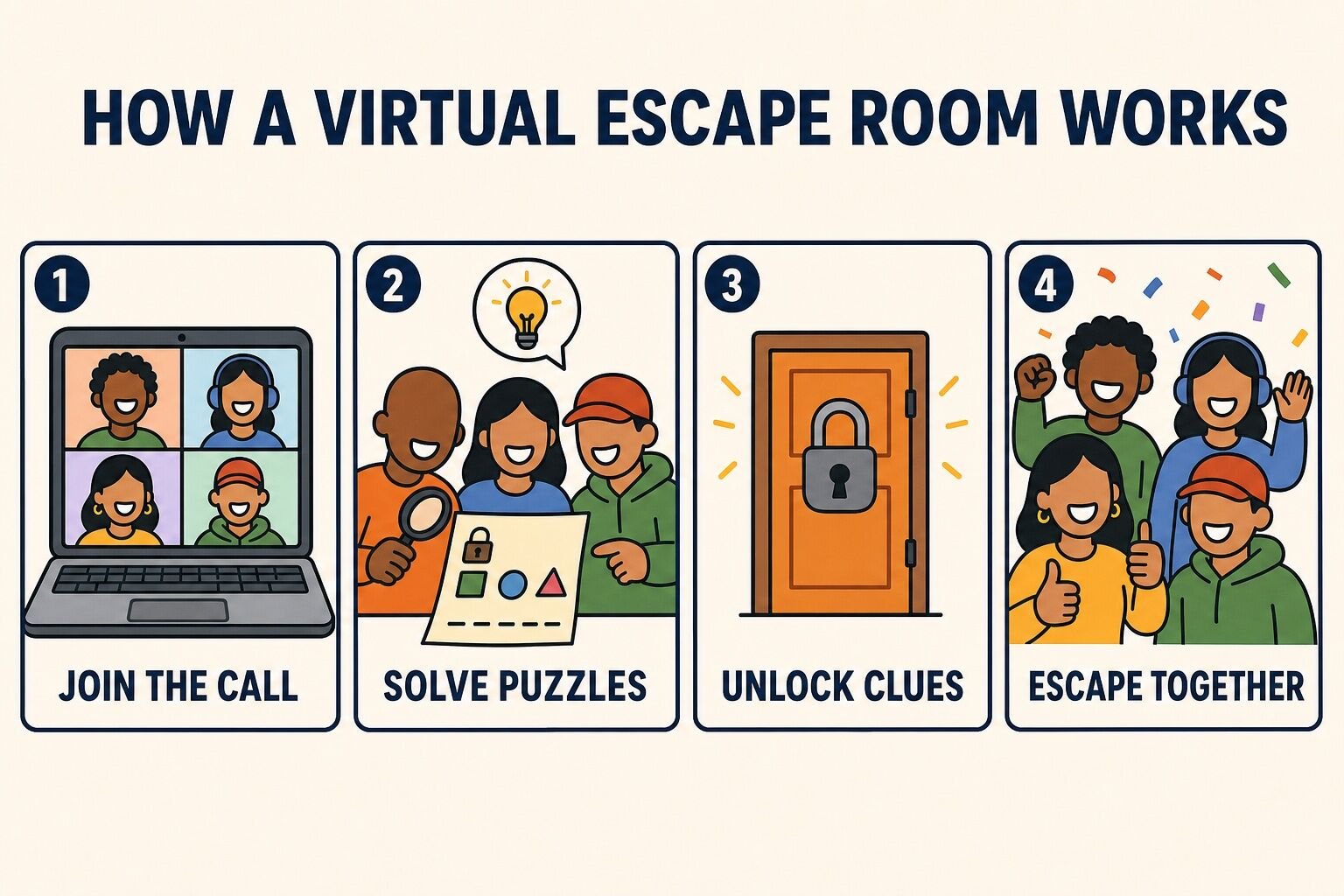
Length. Plan for an hour to 90 minutes. Across confirmed bookings on our platform, 88% of virtual team building events run 60 to 90 minutes, and puzzle games sit at the longer end of that window because the story needs a setup and a payoff. When clients book something shorter, nine times out of ten they tell us afterward that they wish they had booked the full event: under an hour, the session ends right as the quieter teammates warm up.
Platform. Zoom is the default. Among virtual team building events booked on teambuilding.com, clients host 82% on Zoom, 11% on Microsoft Teams, 4% on Google Meet, and 2% on Webex. The practical requirement is breakout rooms plus screen sharing, which all four support.
The host. In a hosted room, the game master is the product. Every teambuilding.com host completes training focused on group dynamics, participant engagement, conflict resolution, and inclusive facilitation, and our most senior hosts have been running groups for close to a decade. That shows up in the reviews: roughly one in five published reviews of our virtual events mentions the host by name.
What players need. A laptop, a working microphone, and a browser tab. Puzzles arrive as shared links, slides, or images, and teams work them in a breakout room while talking. No kits, printing, or prep are required for the hosted formats above, which is what makes them easy to run for a team spread across time zones.
Librarians and museum educators built a surprising number of excellent escape rooms in Google Forms, and most are still online and still free. They are self-guided, so one person shares their screen and the group solves out loud. These six are the ones that hold up with a work team, pulled from the wider set in our free online escape rooms guide. Five are free for any use; Mr. X is free only for home play.
| Activity | Best for | Group size | Time | Cost |
|---|---|---|---|---|
| Hogwarts Digital Escape Room | Nostalgia and easy onboarding | 3–12 | 30–45 min | Free |
| Escape from the TARDIS | A full hour of varied puzzles | 4–12 | 40–60 min | Free |
| Laboratory Labyrinth | Organizers who want a hint guide | 4–20 | 45–60 min | Free |
| Murder Mystery Digital Escape Room | Teams that want to split the work | 4–12 | 30–45 min | Free |
| Mr. X | Large groups in breakout teams | 6–50+ | 45 min–2 hr | Free at home; paid for work |
| Ultra Mega Super Death Escape Room | Experienced players who want difficulty | 3–8 | 45–75 min | Free |
Built by librarians at Peters Township Public Library, this room walks your group through arriving at wizard school for the first time, mixing wizarding-world references with straightforward logic puzzles. It is the friendliest starting point on this list: the puzzles are fair, the form checks your answers, and nobody needs to know the books to contribute.
To run it: share your screen, read each puzzle aloud, and give the group 60 seconds of silent thinking before anyone answers. Assign one person to type answers into the form so the group is not shouting over each other.
Best for: 3 to 12 players, first-timers
Time: 30 to 45 minutes
Materials (cost): Free, plus a shared screen
Learn more: Hogwarts Digital Escape Room
Two library assistants at Chester County Library in Pennsylvania built this Doctor Who room for "puzzle lovers of all ages," and you do not need to know the show to finish it. You play the Doctor's new companion, locked inside the TARDIS, and work through 13 puzzles to find a spare sonic screwdriver: a clock lock, constellations to count on a star map, a chessboard, and a riddle among them.
To run it: split a group of eight or more into two breakout rooms racing the same form, then compare where each team got stuck when you reconvene. The stuck points are usually different, which makes for a better debrief than the finish time.
Best for: 4 to 12 players who want a full hour of varied puzzles
Time: 40 to 60 minutes
Materials (cost): Free
Learn more: Escape from the TARDIS
Campbell County Public Library in Kentucky built the closest thing on this list to a real locked-room game. You wake up in a laboratory, search four corners of the room, and work through about a dozen locks, including a computer password, a message hidden in the periodic table, and a final color sequence. The library also publishes a hint guide and a full answer key, so the organizer can rescue a stuck team without having solved the room first.
To run it: open the hint guide before the call and keep it to yourself. When a team has been stuck on one lock for five minutes, read them the hint for that lock only.
Best for: 4 to 20 players in teams of three to five, ages 13 and up
Time: 45 to 60 minutes
Materials (cost): Free, plus the library's hint guide
Learn more: Laboratory Labyrinth, with the hint guide and answer key on the library's digital escape rooms page
A Clue-style mansion case from Campbell County Public Library in Kentucky. There has been a murder at a party, the suspects are waiting in the ballroom, and you search seven rooms for evidence. Eight answers get you out, including a combination for a locked bag, the weapon, the murderer, and the scene of the crime. You choose which room to search next, which makes it one of the few free rooms where a team can split the work.
To run it: assign each person or pair a room to search, give them five minutes, then have everyone report what they found before anyone types an answer. Keep the library's hint guide open in case the group stalls.
Best for: 4 to 12 players, ages 13 and up
Time: 30 to 45 minutes
Materials (cost): Free, plus the library's hint guide
Learn more: Murder Mystery Digital Escape Room
Mr. X is an online manhunt rather than a locked room: teams follow a trail across public web sources, including maps and video, to track down where the villain is hiding. Because the clues live all over the internet rather than in one form, it scales to a large group better than any Google Form room on this list. One caveat before you send it to your team: its makers, Escape Rooms Durham, offer it free to friends and family with a donation requested, and ask commercial and education customers to pay. Contact them before you run it at work.
To run it: break a big group into teams of four to six, give every team the same starting clue, and set a 60-minute clock, since the makers say it takes anywhere from 45 minutes to 2 hours. Award points for the correct location and a bonus for the team that documents its reasoning best.
Best for: 6 to 50+ players in breakout teams
Time: 45 minutes to 2 hours, per its makers
Materials (cost): Free for home play, donation requested; paid for commercial and education use
Learn more: Mr. X Escape Room
Most free rooms are built for classrooms. This one is built for adults, with harder puzzles, a tongue-in-cheek tone, and a single hint for the whole game. It is the right pick for a group that finished one of the rooms above in 20 minutes and wants a real fight.
To run it: set a timer and agree in advance when you will spend the hint. Groups that save it for the last puzzle almost always finish; groups that burn it early rarely do.
Best for: 3 to 8 experienced players
Time: 45 to 75 minutes
Materials (cost): Free
Learn more: Ultra Mega Super Death Escape Room
A virtual escape room is really a chain of small puzzles that each produce a piece of a final answer. Once you can build the pieces, you can build a room around any story: a product launch, an onboarding week, or your company's own origin story. These are the six puzzle types our game designers use most, in the order we usually chain them.
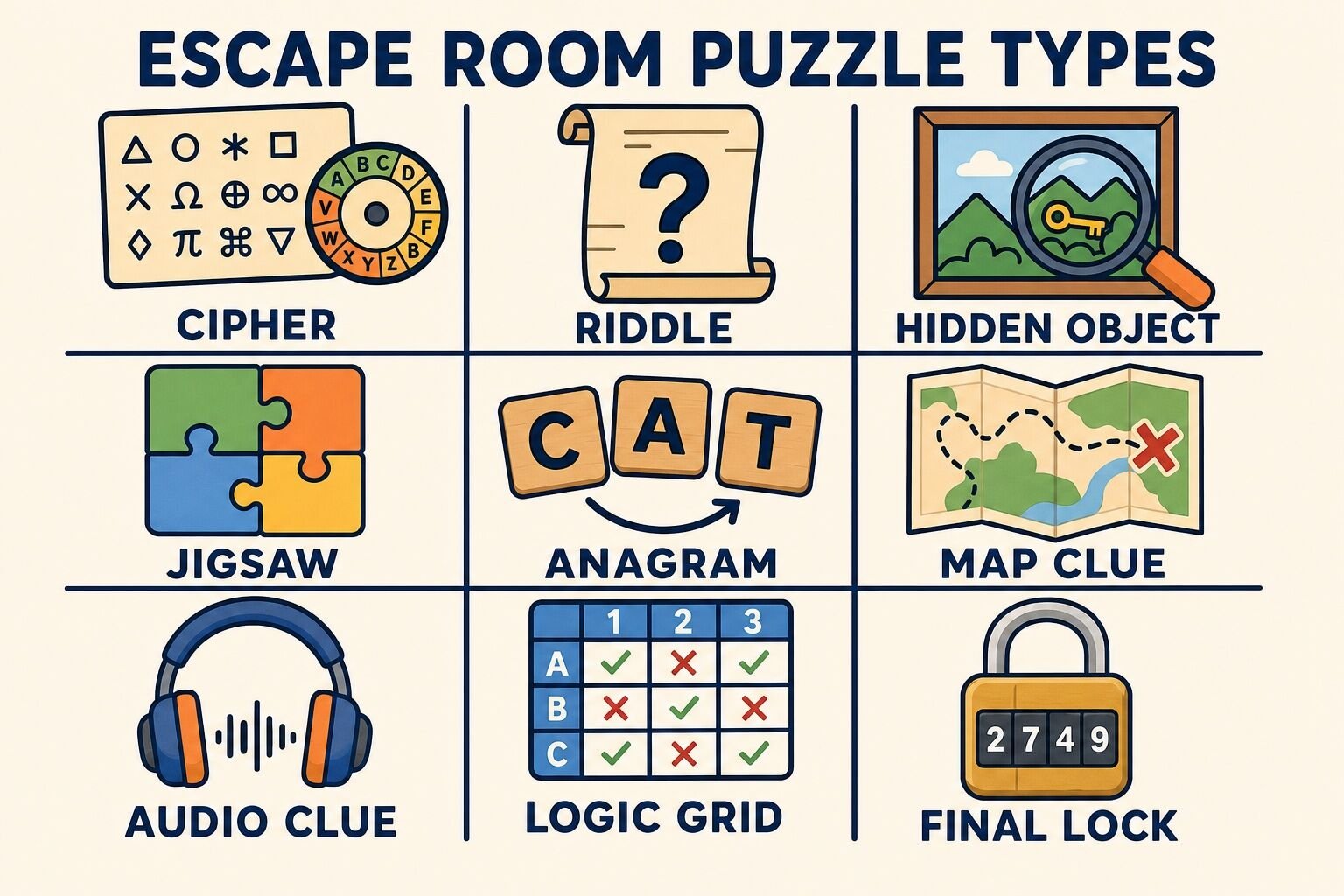
| Activity | Best for | Group size | Time | Cost |
|---|---|---|---|---|
| Substitution cipher | Opening puzzle, teaching the mechanics | 4–30 | 5–10 min | Free |
| Google Form answer lock | Self-checking gates between rounds | 4–100+ | Setup 30 min | Free |
| Hidden-object slide | Quiet observers and mixed skill levels | 4–30 | 5–10 min | Free |
| Riddle chain | Discussion and lateral thinking | 4–20 | 10–15 min | Free |
| Split-information puzzle | Forcing communication across breakouts | 8–50 | 10–20 min | Free |
| Final combination lock | The finale that ties the chain together | 4–100+ | 5–10 min | Free |
A substitution cipher swaps every letter for a symbol, a number, or another letter. It is the classic escape room opener because the solve is mechanical once someone spots the key.
How to build it: pick a short answer word, four to eight letters. Replace each letter with a symbol using a simple, consistent rule, such as A=1, B=2, or a shifted alphabet. Hide the key in plain sight somewhere earlier in the game, for example as a caption under an image or a line in the story. Share the ciphertext as an image so nobody can copy and paste it into a translator.
Best for: 4 to 30 players, opening puzzle
Time: 5 to 10 minutes to solve
Materials (cost): Free, a slide and an image
What we've learned: Put your easiest cipher first. The first puzzle is not there to challenge the group, it is there to teach them that the clues are fair, so that they trust the harder ones later.
The answer lock is the free equivalent of a padlock: a form question that only advances when the correct answer is typed. It is how nearly every free room on this list is built.
How to build it: create a Google Form with one section per round. In each section, add a short-answer question, open response validation, and set it to "Regular expression matches" with your answer, case-insensitive. Set the section to loop back on itself when the answer is wrong, and to continue to the next section when it is right. Write the failure message in the voice of your story rather than as an error.
Best for: 4 to 100+ players, any self-guided room
Time: About 30 minutes to set up
Materials (cost): Free, Google Forms
What we've learned: Accept the near-misses. Allow singular and plural, with and without spaces, and common misspellings. Nothing kills a room faster than a team that solved the puzzle correctly and cannot get past the gate.
One busy image, one small detail that matters. A hidden-object puzzle asks the group to find the four-digit number painted on a boat's hull, or the one book on a shelf with no title.
How to build it: take a detailed illustration or photograph, then edit in your clue at small scale, somewhere that is visible but not central. Share it full-screen and let people claim regions of the image out loud, for example "I have the bookshelf, you take the desk," so the search is divided rather than duplicated.
Best for: 4 to 30 players, mixed skill levels
Time: 5 to 10 minutes
Materials (cost): Free, one image
What we've learned: These puzzles are the great equalizer in our rooms. Spotting a detail does not require speaking first or fastest, so hidden-object rounds are usually where the quietest person on the call gets the win.
A riddle chain is three or four riddles whose answers combine into one word or number. Riddles are slower than ciphers and produce more conversation, which makes them the best mid-game puzzle for a team building event.
How to build it: pick riddles whose answers start with the letters you need, then have the group assemble the first letters into the round's answer. Our lists of icebreaker riddles and scavenger hunt clues are good source material. Keep each riddle under two sentences.
Best for: 4 to 20 players, mid-game
Time: 10 to 15 minutes
Materials (cost): Free
What we've learned: Three riddles is the limit. Groups enjoy the first two, debate the third, and go quiet on the fourth. If you need a longer round, switch puzzle types rather than adding another riddle.
Each player receives a different fragment of the clue, and no fragment is solvable alone. This is the puzzle type that actually builds communication skills, because the only way through is to describe what you are holding.
How to build it: write a short answer that requires four facts, then privately send each player one fact by direct message before the round starts. For example, one person has a color key, another has the order of the symbols, a third has the rotation, and the fourth has the format of the final answer. Give the group a deadline and stay out of it.
Best for: 8 to 50 players in breakout rooms
Time: 10 to 20 minutes
Materials (cost): Free, plus direct messages
What we've learned: Groups that solve these fastest do the same thing first: they stop, go around the room once so everyone states what they have, then assign who does what. Groups that start acting immediately spend the first five minutes talking over each other.
The finale collects one digit or letter from each earlier round into a single code. It is what turns a set of puzzles into an escape room, because it gives every round a visible purpose.
How to build it: label each round's answer with the position it fills in the final code, for example "this is digit 3 of 4." Show an image of a four-digit padlock on screen from the very beginning and fill in the digits as teams earn them. Reveal the lock opening with a short story beat, not just a "correct" message.
Best for: 4 to 100+ players, the last five minutes
Time: 5 to 10 minutes
Materials (cost): Free, one slide
What we've learned: Show the lock early. When teams can see the empty slots from minute one, they track their own progress, and the finish feels earned instead of announced.
Escape rooms earn their place in corporate team building because the game does the work that a workshop usually has to argue for. A group has a shared goal, a hard deadline, and information spread across several people, which is a fair simulation of most projects. We call this stealth team building: participants come for the games and the laughter, and leave having practiced communication, collaboration, and connection.
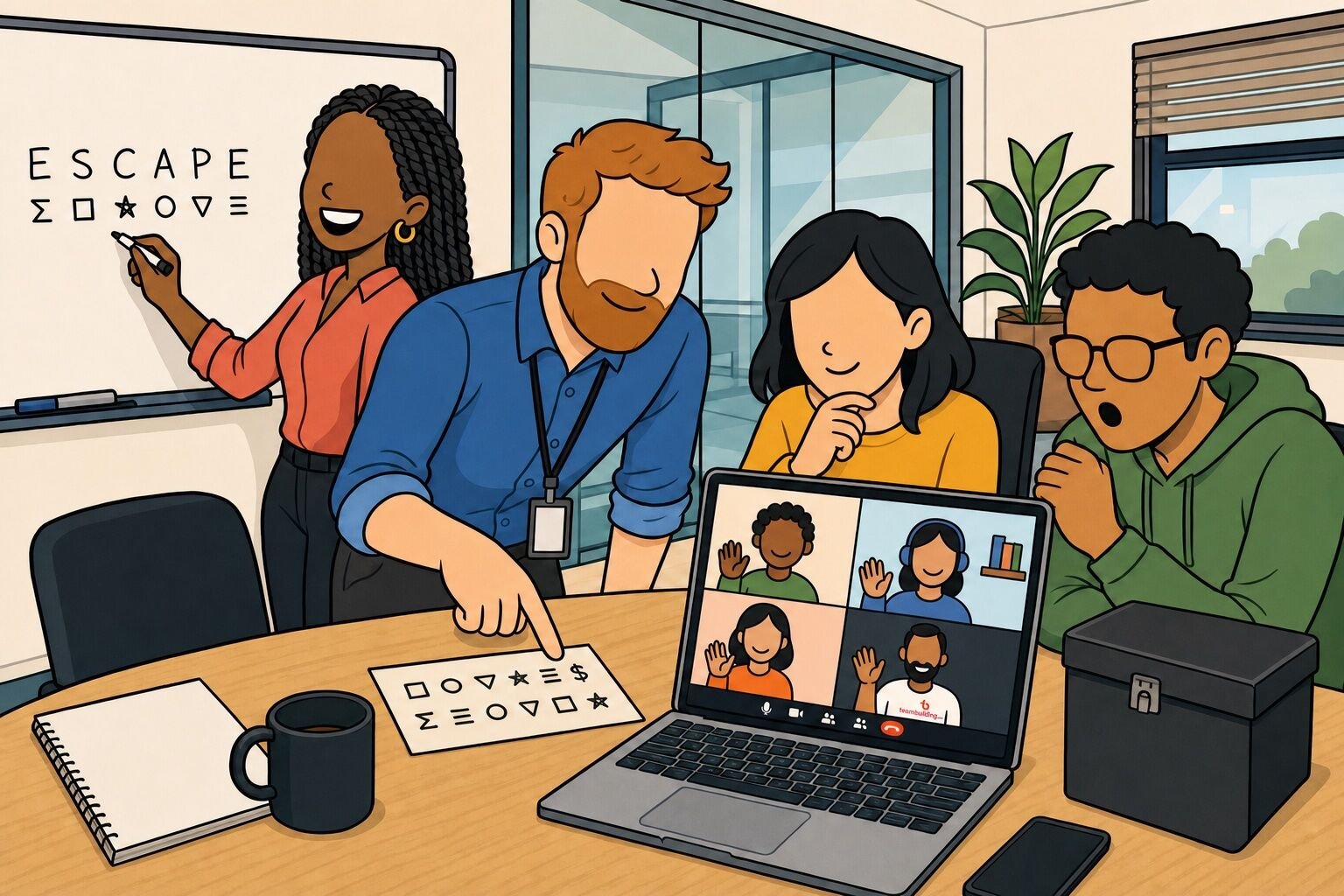
The research on structured team interventions supports the format, with a caveat. A meta-analysis of 72 controlled teamwork-training studies covering 8,439 participants, published in PLoS ONE by McEwan and colleagues (2017), found medium-to-large improvements in teamwork behaviors and team performance, with experiential methods such as workshops and simulations among the effective approaches. An escape room is not teamwork training, but it shares the ingredients that those interventions have in common: a task that requires coordination, roles that emerge under time pressure, and a conversation afterward about how the group worked.
That last part is the one teams skip. To turn a fun hour into team building, spend five minutes at the end on three questions: where did we get stuck, who ended up leading which part, and what would we do differently with the same amount of time? The answers carry over to real projects more reliably than the puzzles do.
That review is for Murder in the Speakeasy, and it describes the structure we aim for in every puzzle game: a story worth following, puzzles that are hard enough to matter, and a competitive frame that gives a room of colleagues a reason to talk to each other.
Escape games are also a useful step up from lighter formats. If your team is new to online events, start with video call games or a virtual game night, then graduate to a puzzle room once people are comfortable talking on camera.
Puzzle games scale better than almost any other virtual format, because the solving happens in small teams while the story happens in the main room. The median virtual event we run is a team of 16, but we have hosted 448 virtual events with 100 or more participants, the largest with over 1,000 attendees.
The structure that makes that work is the same at every size. Split the group into teams of four to six, send each team to its own breakout room with the same puzzle set, keep a visible countdown and leaderboard in the main room, and bring everyone back for the finale. In our experience, roughly 15 people is the practical dividing line for Zoom events: below it, a room can run personal and high-touch with many short rounds, and above it you need breakout rooms and structured hosting.
Three things break at scale, and all three are fixable in advance:
For groups past 100, see our guides to virtual team building for large groups and virtual games for large groups.
"Virtual breakout rooms" means two different things, and searchers use it both ways. Sometimes it means the escape room itself, borrowing the British term "breakout room" for what Americans call an escape room. More often it means the video-call feature that splits a call into smaller rooms. Virtual escape rooms use the second to deliver the first.
Either way, the feature is what makes a puzzle game work with more than a handful of people. Practical settings we use in every hosted room: pre-assign participants rather than randomizing, allow players to return to the main room on their own, broadcast time warnings to all rooms at the halfway and five-minute marks, and set the closing countdown to 30 seconds so conversations can land.
If you want more to do with the feature outside of a puzzle game, our list of Zoom breakout room ideas covers formats that use the same mechanics, and Zoom games has shorter options for a single meeting.
A few patterns show up across thousands of hosted puzzle games and the post-event surveys that follow them.
Teams of four to six are the sweet spot. Below four, one quiet person can disappear into the background. Above six, at least one player stops contributing to the puzzle and starts narrating it. When a client wants larger teams for social reasons, we give each team a second, parallel puzzle so there is enough work to go around.
Difficulty should ramp, not spike. Our designers front-load the easy wins deliberately. A group that solves two puzzles quickly will fight through a hard third one; a group that hits the hard puzzle first often decides, quietly, that the game is not for them.
The debrief is where the team building happens. In a study of 51 work teams, Harvard's Amy Edmondson found that team psychological safety, a shared belief that the team is safe for interpersonal risk-taking, enables team learning behavior, which in turn drives team performance (Administrative Science Quarterly, 1999). A five-minute debrief where people can say "I was completely lost on puzzle two" without consequence is a small, cheap rehearsal of exactly that.
Competition raises engagement, and a scoreboard raises it more. Teams that can see where they stand push harder in the last ten minutes. Keep the scores close enough to matter and stop updating the board with two minutes left, so nobody gives up before the finale.
Group size changes the plan. Here is what we adjust at either end.
| Small groups (under 15) | Large groups (30+) | |
|---|---|---|
| Best formats | Free browser rooms, a hosted 60-minute game, a DIY riddle chain | Hosted 90-minute games, split-information puzzles, a manhunt like Mr. X |
| Structure | One room, everyone on one puzzle, no breakouts | Teams of 4 to 6 in pre-assigned breakouts with a visible leaderboard |
| Host role | Play along and hint sparingly | Run the main room, keep time, and announce standings between rounds |
| Watch out for | One fast solver finishing the game for everyone | Transition time between breakouts and the main room |
The format is older than the video call. Our sister company Museum Hack was running puzzle events in museums years before we moved them online. Bloomberg Businessweek's 2018 feature, "Renegade Museum Tours Lure Newbies, Bros, and the Easily Bored," covered one of those events at the ASU Art Museum, which filled 150 slots in 24 hours. The appetite for puzzles in a group was there long before anyone needed a Zoom link.
Not every online escape room is worth an hour of your team's time. These are the versions we have seen fail, and what to do instead.
| Activity | Why skip it | Verdict |
|---|---|---|
| Photographed physical rooms | A real escape room's puzzles depend on handling objects. Photographed and pasted into slides, they become a slideshow where one person clicks and everyone else watches. | Skip it |
| Self-guided rooms for 30+ people | Without a host and breakouts, a large group turns into three people solving and 27 people spectating with their cameras off. | Needs a host |
| Trivia dressed up as an escape room | If every "puzzle" is a general-knowledge question, the game rewards who knows things rather than how the group works together. Book trivia games instead and call it trivia. | Mislabeled |
| Rooms with no hint system | Every group gets stuck. With no hint path, a stuck group stays stuck, and the hour ends in frustration instead of a finish. | Skip it |
| Two-hour marathon rooms | Attention on a video call does not survive two hours of puzzles. 88% of the virtual events on our platform run 60 to 90 minutes, and puzzle games are no exception. | Too long |
| Horror rooms for the whole company | Genuinely scary rooms are great for a self-selected group and a bad surprise for a mandatory all-hands. Pick an atmospheric story instead, or make attendance optional. | Use with care |
| Escape rooms as performance reviews | Scoring individuals on "problem-solving" during a game turns a fun hour into an evaluation, and people play not to lose rather than to solve. | Don't |
| Rooms that require printing | Any format that asks a remote team to print and cut out materials loses the third of the group that has no printer at home. | Skip it |
A good virtual escape room does something very few online formats manage: it gives a remote team a real reason to talk to each other for an hour. The story is the excuse, the clock creates the urgency, and the puzzles make sure everyone has something to contribute. Whether you book a host, play a free browser room, or build your own puzzle chain, the ingredients are the same: small teams, a fair difficulty ramp, and five minutes at the end to talk about how it went.
If you would rather have a trained host run it, browse our virtual team building events, or start with Solverance and Escape Everest: Quest for the Yeti.
Next, check out our lists of virtual team challenges, virtual game show ideas, and online group games.
Answers based on the virtual escape rooms we host and platform data from 40,000+ virtual events.
A virtual escape room is an online game where a group solves ciphers, riddles, and hidden-object puzzles inside a themed story, racing a clock to "escape" before time runs out. Hosted versions run on a video call with a live game master who narrates the story and drops hints. Self-guided versions run in a browser, usually as a Google Form that checks your answers. These games are also called online escape rooms, digital escape rooms, Zoom escape rooms, and virtual breakout rooms.
Everyone joins one video call, the host sets up the story, and the group splits into teams of four to six in breakout rooms. Each team works through a chain of puzzles whose answers combine into a final code, then the room reconvenes for the finale and a short debrief. Players need a laptop, a microphone, and a browser tab. Puzzles arrive as shared links, slides, or images, so there is nothing to print or ship.
Hosted virtual escape rooms on teambuilding.com run $40 to $49 per person, for example Escape Everest: Quest for the Yeti at $40 and Solverance at $49. Other operators typically quote custom pricing by group size. Free options exist too: librarians and museum educators have built dozens of Google Form escape rooms that cost nothing, though you supply the host.
Plan for 60 to 90 minutes. Across confirmed bookings on our platform, 88% of virtual team building events run 60 to 90 minutes, and puzzle games sit at the longer end because the story needs a setup and a payoff. Free browser rooms are shorter, usually 30 to 45 minutes. When clients book something under an hour, they often tell us afterward that the session ended right as the quieter teammates were warming up.
Yes. Puzzle games scale better than most virtual formats because the solving happens in small breakout teams while the story happens in the main room. Split the group into teams of four to six, pre-assign breakout rooms, keep a visible countdown and leaderboard, and reconvene for the finale. The median virtual event we run has 16 participants, but we have hosted 448 virtual events with 100 or more people, the largest with over 1,000 attendees.
Chain four to six small puzzles whose answers each contribute one digit or letter to a final code. Start with an easy substitution cipher to teach the mechanics, add a hidden-object slide and a riddle chain, and include one split-information puzzle where each player holds a different fragment. Build the gates in Google Forms with response validation so the game checks answers for you, accept near-miss spellings, and show the final padlock on screen from the beginning so teams can track their progress.
Hey we are a suicide prevention coalition in Middle Georgia. We usually do a live youth rally with local 10th graders - we are now looking for virtual format and we are thinking about escape rooms type activities.
Hi Tina -- Thanks for sharing about your mission, and best wishes for your event!
I want to create an escape room as a fun activity for the secretaries I work with. We have a once a month fun day and this was a suggested activity. We work mostly with and on Microsoft teams. Are your escape rooms only tailored for Zoom or can they be used on teams as well, because I would love to play the Hogwarts escape room and I already know my secretaries would love to explore this particular room.
Please advise?
Thank you.
Hi Germaine! Most of our virtual event types are built for Zoom, but we do have options for Microsoft Teams. For example, "Espinoage" has similar game dynamics with the online escape rooms. You can email info@teambuilding.com any time for booking support. Best wishes!
Hello,
I am looking to book multiple escape room games for our huge team of 60 people.
Broken down into 10 people in each team for a tentative game time of 30 mins only per team.
Do you have any suggestions on which game would be a viable option?
Hello,
I would like to know which escape room do you recommend for team building? Also, I would like to know the cost of an event hosted by your company.
Thank you,
Cherry
Hi Cherry! The first step for planning an event is to fill out the form on the front page of our site. Then our team will send you the up-to-date price list, and you can schedule a call if you'd like to discuss options. Thanks and best wishes!
I would like more information for my nonprofit organization for a possible fundraiser. Please contact me.